
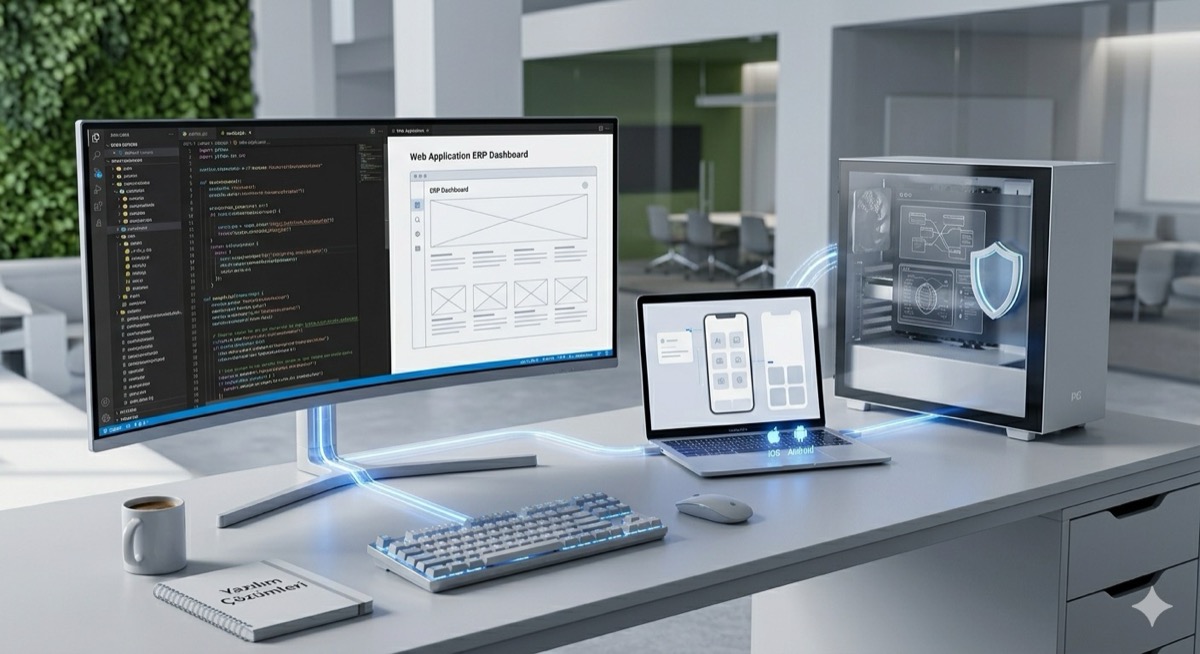
Do you need software? We manage all processes from the analysis stage to coding, installation, and post-sales technical support from a single source to provide solutions that make your business easier. We ensure that you receive all the software services you need in a complete and professional manner from a single point, without you having to deal with complex processes.
Digital transformation is no longer a choice; it is a fundamental requirement for sustainable growth. The success of a modern business depends on how efficiently it digitalizes its business processes and how accurately it manages this data. Today, a “single software” is not enough to solve every problem. True efficiency is possible with integrated software ecosystems where web, mobile, and desktop platforms work in full harmony with each other.
In this article, we will discuss the professional software solutions your business needs, along with their technological depth and sectoral advantages.
Web Software Solutions: Global Accessibility and Scalability
Web-based software is the digital headquarters of a business. These solutions, ranging from corporate websites to complex ERP (Corporate Resource Planning) systems, provide access from anywhere with an internet connection without requiring any hardware installation.
Cloud Integration and Corporate Identity
Modern web software offers unlimited scalability thanks to cloud technologies. As your business grows, your software infrastructure can expand accordingly.
-
Centralized Management: All branches and departments access up-to-date information through a single database.
-
SaaS Models: Operational costs are reduced with the Software as a Service approach.
-
SEO and Trust: A fast and secure web infrastructure that reflects your corporate identity ensures you rank high in modern search technologies like Google SGE (Search Generative Experience).
Mobile Application Development: Interaction Anytime, Anywhere
Mobility takes business processes outside the office walls. From field operations to customer loyalty programs, mobile applications are the most effective way to maximize user experience (UX).
iOS, Android and Cross-Platform Dynamics
Choosing the right technology stack is a critical decision for businesses.
-
Native Applications: These apps, developed separately for iOS (Swift) and Android (Kotlin), offer the highest performance and hardware compatibility.
-
Cross-Platform Solutions: Applications can be developed for both platforms using a single codebase with technologies like Flutter or React Native. This is ideal for businesses looking for cost and speed advantages.
-
Field Operations: Mobile solutions are vital for warehouse management, logistics tracking, and sales teams to perform real-time data entry.
Desktop Software: High Performance and Data Security
Despite the rise of web and mobile, desktop software remains indispensable in areas requiring high processing power and maximum data security.
Powerful Performance and Offline Working Advantages
Processing large data sets, complex graphic rendering, or production line automation are the specialties of desktop software.
-
Hardware Access: It utilizes the computer’s CPU, GPU, and RAM capacity most efficiently.
-
Offline Operation: It ensures that business processes do not stop even when the internet connection is lost.
-
High Security: It is the safest harbor in cases where sensitive data must be kept on the local network (on-premise).
Sectoral Software Solutions: Tailor-Made Approaches
Custom software development creates solutions tailored to the business’s DNA where ready-made package programs fall short.
-
Manufacturing Sector: Reducing the margin of error to zero with IoT-integrated production tracking systems.
-
Health Sector: Compliance with data protection regulations for patient tracking and appointment management platforms.
-
Trade and E-Commerce: Omni-channel sales and stock management integrations.
-
Logistics: Real-time route optimization and fleet tracking systems.
Why Should Custom Software Development Be Preferred?
Businesses often face the dilemma of “ready-made package software or custom software?” Custom software solutions provide the following advantages:
-
Full Compatibility: Instead of fitting your workflow to the software, you shape the software according to your workflow.
-
Sustainable Efficiency: A fast structure is established, stripped of unnecessary features and focused only on the need.
-
Intellectual Property: The ownership of the software belongs entirely to you, freeing you from license fee dependencies.
Frequently Asked Questions (FAQ)
1. Which type of software is more suitable for my business?
This depends on your intended use. If you want to reach your customers from anywhere, Mobile; for general management and accessibility, Web; and for heavy data processing and high performance, Desktop solutions should be preferred. The ideal is a system where these three work integrated.
2. How long does the custom software development process take?
The duration varies depending on the scope and complexity of the project. However, a standard process covers analysis, design, development, testing, and deployment stages, and the first phase is generally expected to be completed within 3 to 6 months.
3. Is a cross-platform mobile application secure?
Yes, today technologies like Flutter and React Native offer enterprise-level security. These technologies are used securely in many sectors, including finance and banking.
4. How does the software maintenance and support process work?
Software is a living organism. A regular maintenance and support agreement is critical for the continuity of the system for technological updates, security patches, and new feature additions.
5. Can I integrate my existing systems into the new software?
Yes. Modern software can be seamlessly communicated with the accounting, CRM, or e-commerce infrastructures you already use via APIs (Application Programming Interface).

