
Why Is the Sky Blue? Rayleigh Scattering Explained
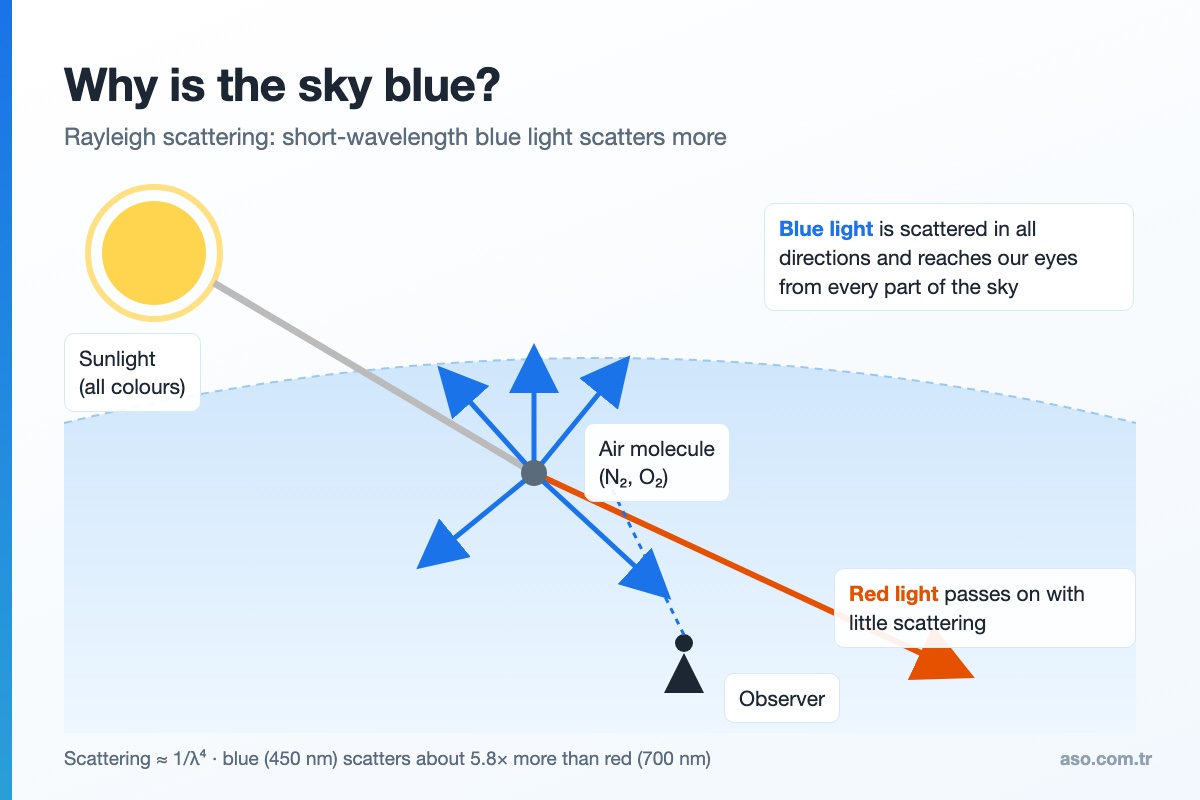
Why is blue light scattered more?
Sunlight contains all the colours of the rainbow. Violet and blue light have short wavelengths (about 400–450 nm), red light long ones (about 700 nm). Air molecules, much smaller than these wavelengths, scatter light in all directions, and the strength of scattering is inversely proportional to the fourth power of the wavelength (≈ 1/λ⁴). Blue light is therefore scattered much more and reaches us from everywhere in the sky. Lord Rayleigh explained this mathematically in 1871.
Why isn’t the sky violet?
Violet is scattered even more than blue, but sunlight contains less violet and our eyes are less sensitive to it, so we perceive the sky as light blue.
Why are sunsets red and orange?
Near the horizon sunlight travels a much longer path through the atmosphere. Most of the blue is scattered away on the way, leaving mainly orange and red light.
Why are clouds white and overcast skies grey?
Cloud droplets are much larger than the wavelength of light and scatter all colours roughly equally (Mie scattering), so clouds look white. Thick clouds block light and look grey.
Why is the sky black in space?
Without an atmosphere there is nothing to scatter light, so the sky in space and on the Moon is black even in daytime. On Mars, dust makes the daytime sky yellowish-brown and sunsets bluish.
More popular questions
Frequently asked questions
Why is the sky blue?
Sunlight is scattered by air molecules; short-wavelength blue light is scattered far more than red, so blue reaches our eyes from all directions. This is Rayleigh scattering.
What is Rayleigh scattering?
Scattering of light by particles much smaller than its wavelength; its strength is proportional to 1/λ⁴, so blue scatters about 5–6 times more than red.
Why are sunsets red?
At sunset light travels a longer path through the air; blue is scattered away and mostly orange and red light reaches us.


Comments (0)