
Barcode Standards
Main barcode standards
| Standard | What it encodes | Length | Typical use |
|---|---|---|---|
| EAN-13 | Digits only | 13 digits | Retail products |
| EAN-8 | Digits only | 8 digits | Small packages |
| UPC-A / UPC-E | Digits only | 12 / 8 digits | US and Canadian retail |
| Code 128 | All 128 ASCII characters | Variable | Logistics, cartons, serial numbers; GS1-128 |
| Code 39 | A–Z, 0–9 and – . space $ / + % (all ASCII in Full ASCII mode) | Variable | Industry, inventory, asset tags |
| Interleaved 2 of 5 (ITF) | Digits only, even number of digits | Variable (ITF-14: 14) | Cartons and outer packaging |
| Codabar | 0–9, – $ : / . + and A–D start/stop | Variable | Libraries, blood banks, courier |
| QR, Data Matrix, PDF417 | Letters, digits and long text (2D) | Variable | Payments, pharmaceutical codes, ID cards |
More: Datamatrix barcode usage · QR code creation · Sequential barcodes
Structure of an EAN-13 barcode
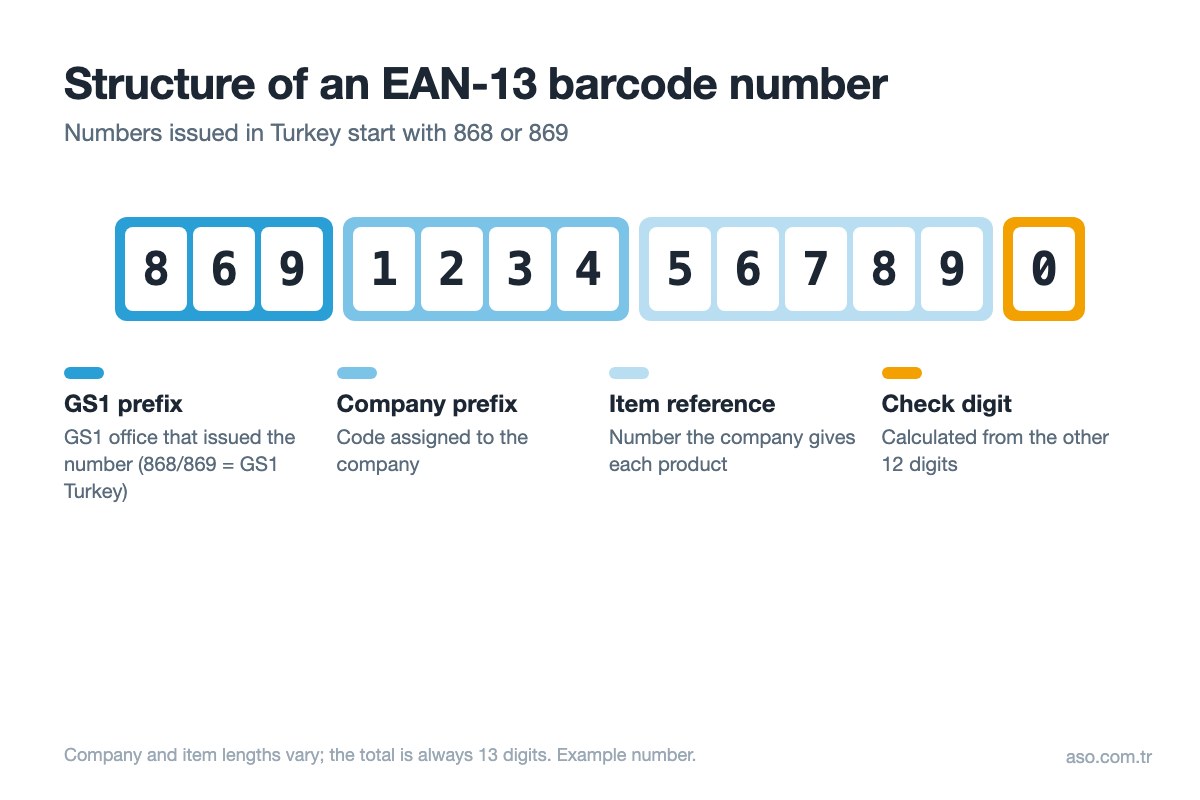
- GS1 prefix (2–3 digits): the GS1 organisation that issued the number; 868 and 869 for Turkey.
- Company prefix: the code assigned to the company; its length depends on the company’s needs.
- Item reference: the number the company gives each product.
- Check digit (last digit): calculated from the other 12 digits to catch scanning errors.
How to calculate the check digit: multiply the first 12 digits alternately by 1 and 3 from the left, add them up, and take the number that brings the total to the next multiple of 10. Example: 590123412345 → total 83 → check digit 7 → 5901234123457. Barcode Label Pro calculates it automatically.
EAN-8 is the short 8-digit version for small packages. UPC-A (12 digits) is used in the US and Canada and can be read as EAN-13 with a leading 0.
How to get barcode numbers in Turkey
EAN-13 numbers for retail products are obtained by joining GS1 Turkey (part of TOBB). Once the company prefix is assigned, the company numbers its own products. For in-store or internal use (shelves, variable-weight items, assets), restricted numbers starting with 2 or standards such as Code 128 can be used.
Barcode examples
Code 128 – encodes all 128 ASCII characters; can carry weight, date, lot and location data: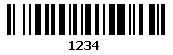
Code 39 – simple and easy to read, but produces long barcodes:
Interleaved 2 of 5 – digits only, even number of digits; the ITF-14 carton barcode is based on it: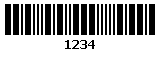
Which country is a barcode from? GS1 prefix list
Filter by the first 3 digits of the barcode (e.g. 869) or by country name.
| Prefix | GS1 organisation / use |
|---|---|
| 001–019 | United States (UPC-A compatible) |
| 020–029 | Restricted circulation within a region (UPC-A compatible) |
| 030–039 | United States (US drugs (National Drug Code)) |
| 040–049 | Restricted circulation within a company (UPC-A compatible) |
| 050–059 | GS1 US – reserved for future use |
| 060–099 | United States (UPC-A compatible) |
| 100–139 | United States |
| 200–299 | Restricted circulation within a region or company (e.g. variable-weight items) |
| 300–379 | France and Monaco |
| 380 | Bulgaria |
| 381 | Kosovo (Previously used 390 unofficially) |
| 383 | Slovenia |
| 385 | Croatia |
| 387 | Bosnia and Herzegovina |
| 389 | Montenegro |
| 400–440 | Germany (440 inherited from former East Germany) |
| 450–459 | Japan (Japan new range) |
| 460–469 | Russia (Inherited from the Soviet Union) |
| 470 | Kyrgyzstan |
| 471 | Taiwan |
| 474 | Estonia |
| 475 | Latvia |
| 476 | Azerbaijan |
| 477 | Lithuania |
| 478 | Uzbekistan |
| 479 | Sri Lanka |
| 480 | Philippines |
| 481 | Belarus |
| 482 | Ukraine |
| 483 | Turkmenistan |
| 484 | Moldova |
| 485 | Armenia |
| 486 | Georgia |
| 487 | Kazakhstan |
| 488 | Tajikistan |
| 489 | Hong Kong |
| 490–499 | Japan (Japan original range) |
| 500–509 | United Kingdom |
| 520–521 | Greece |
| 528 | Lebanon |
| 529 | Cyprus |
| 530 | Albania |
| 531 | North Macedonia |
| 535 | Malta |
| 539 | Ireland |
| 540–549 | Belgium and Luxembourg |
| 560 | Portugal |
| 569 | Iceland |
| 570–579 | Denmark, Faroe Islands and Greenland |
| 590 | Poland |
| 594 | Romania |
| 599 | Hungary |
| 600–601 | South Africa |
| 603 | Ghana |
| 604 | Senegal |
| 605 | Uganda |
| 606 | Angola |
| 607 | Oman |
| 608 | Bahrain |
| 609 | Mauritius |
| 611 | Morocco |
| 612 | Somalia |
| 613 | Algeria |
| 615 | Nigeria |
| 616 | Kenya |
| 617 | Cameroon |
| 618 | Côte d'Ivoire |
| 619 | Tunisia |
| 620 | Tanzania |
| 621 | Syria |
| 622 | Egypt |
| 623 | GS1 Global Office – for a future member organisation (Brunei until 2021) |
| 624 | Libya |
| 625 | Jordan |
| 626 | Iran |
| 627 | Kuwait |
| 628 | Saudi Arabia |
| 629 | United Arab Emirates |
| 630 | Qatar |
| 631 | Namibia |
| 632 | Rwanda |
| 640–649 | Finland |
| 680–681 | People's Republic of China |
| 690–699 | People's Republic of China |
| 700–709 | Norway |
| 729 | Israel |
| 730–739 | Sweden |
| 740 | Guatemala |
| 741 | El Salvador |
| 742 | Honduras |
| 743 | Nicaragua |
| 744 | Costa Rica |
| 745 | Panama |
| 746 | Dominican Republic |
| 750 | Mexico |
| 754–755 | Canada |
| 759 | Venezuela |
| 760–769 | Switzerland and Liechtenstein |
| 770–771 | Colombia |
| 773 | Uruguay |
| 775 | Peru |
| 777 | Bolivia |
| 778–779 | Argentina |
| 780 | Chile |
| 784 | Paraguay |
| 786 | Ecuador |
| 789–790 | Brazil |
| 800–839 | Italy, San Marino and Vatican City |
| 840–849 | Spain and Andorra |
| 850 | Cuba |
| 858 | Slovakia |
| 859 | Czechia (Inherited from Czechoslovakia) |
| 860 | Serbia (Inherited from Yugoslavia) |
| 865 | Mongolia |
| 867 | North Korea |
| 868–869 | Türkiye (Turkey) |
| 870–879 | Netherlands |
| 880–881 | South Korea |
| 883 | Myanmar |
| 884 | Cambodia |
| 885 | Thailand |
| 887 | Laos |
| 888 | Singapore |
| 890 | India |
| 893 | Vietnam |
| 894 | Bangladesh |
| 896 | Pakistan |
| 899 | Indonesia |
| 900–919 | Austria |
| 930–939 | Australia |
| 940–949 | New Zealand |
| 950 | GS1 Global Office – countries and territories without a GS1 member organisation |
| 951 | EPC General Identifier (GID) scheme |
| 952 | Demonstrations and examples of the GS1 system |
| 955 | Malaysia |
| 958 | Macao |
| 960–9624 | GS1 UK – GTIN-8 allocations |
| 9625–9626 | GS1 Poland – GTIN-8 allocations |
| 9627–969 | GS1 Global Office – GTIN-8 allocations |
| 977 | Serial publications (ISSN) |
| 978–979 | Books (ISBN-13); 979-0 sheet music (ISMN) |
| 980 | Refund receipts |
| 981–983 | Coupons for common currency areas |
| 990–999 | Coupons |
Source: GS1 Company Prefix list (October 2026).
Print barcodes with Barcode Label Pro
Barcode Label Pro supports 42 barcode standards including EAN-13, EAN-8, UPC, Code 128, Code 39, Codabar, ITF, QR, Datamatrix and PDF417, calculates check digits automatically and prints labels in bulk from Excel lists. Program features · Sample labels · Pricing (in Turkish)
Frequently asked questions
How many digits does a barcode number have?
An EAN-13 barcode used on retail products has 13 digits. EAN-8 for small packages has 8 digits, UPC-A used in the US and Canada has 12 digits and the ITF-14 carton barcode has 14 digits.
Which country uses the 869 barcode prefix?
Barcode numbers starting with 868 and 869 are issued by GS1 Turkey. However, the prefix shows which GS1 organisation issued the number, not the country where the product was made.
Do the first digits of a barcode show the country of origin?
No. The GS1 prefix shows which national GS1 organisation the company obtained its barcode number from. A company can manufacture in another country and still use its own country’s prefix.
Where do I get barcode numbers in Turkey?
EAN-13 numbers for retail products are obtained by joining GS1 Turkey, which operates within TOBB. Using random numbers can clash with another company’s products.
How is the EAN-13 check digit calculated?
Multiply the first 12 digits alternately by 1 and 3 from the left and add them up; the check digit is the number that brings the total up to the next multiple of 10. For 590123412345 the total is 83, so the check digit is 7 and the full number is 5901234123457.
What is the difference between Code 128 and Code 39?
Code 39 uses a 43-character set of upper-case letters, digits and a few symbols and produces long barcodes. Code 128 encodes all 128 ASCII characters and fits the same data into a shorter barcode; it is widely used in logistics.


Comments (0)